Overview
Selecting any of the top AI-enriched tasks opens the Recommendation details page.
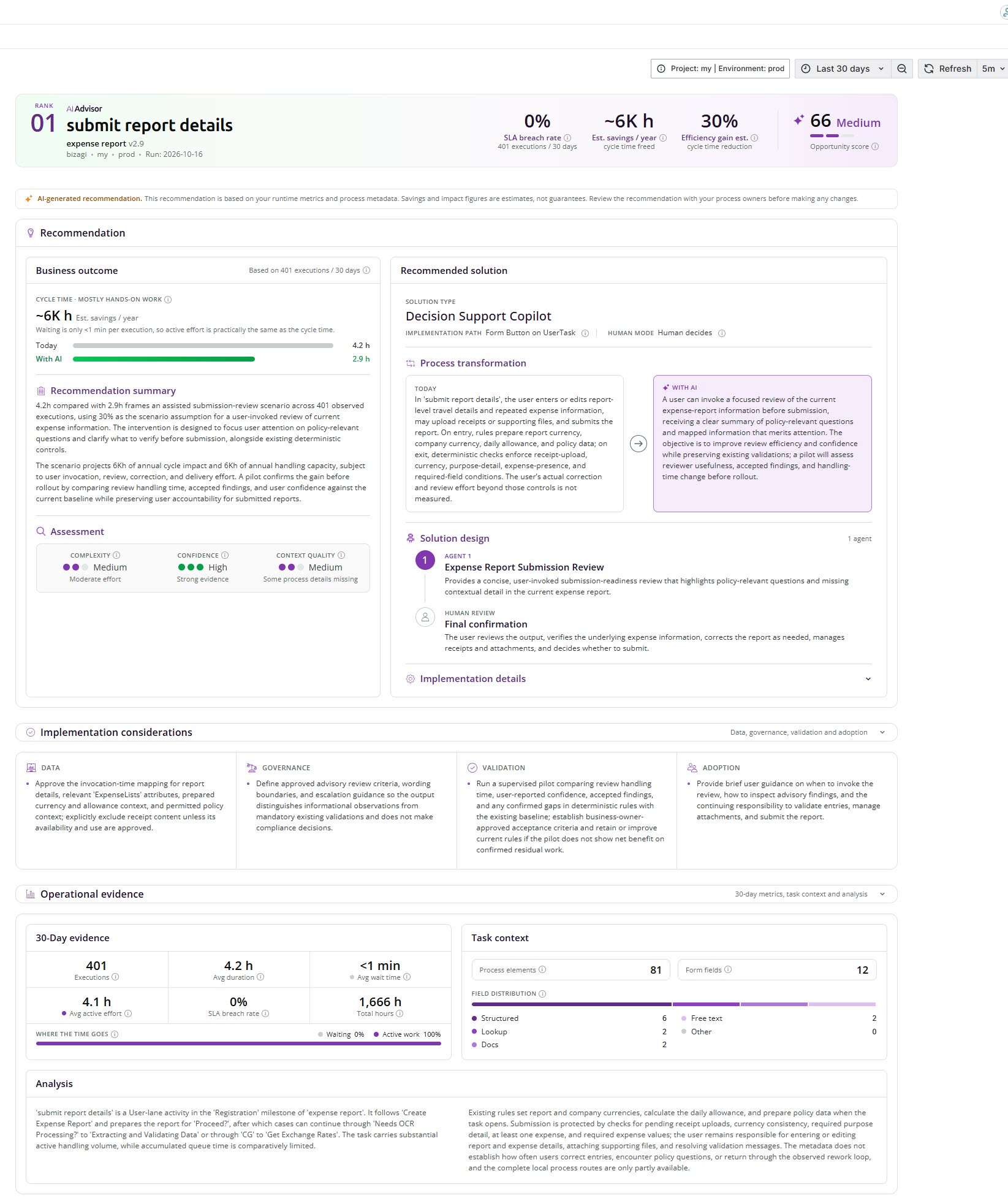
The AI Recommendation details page provides an in-depth view of an automation opportunity identified by AI Advisor. It brings together the operational evidence that led to the opportunity, the expected business outcome, and a proposed AI solution that can help optimize the task.
AI Advisor generates these recommendations using process execution statistics and application metadata. Recommendations and their expected impact are AI-generated estimates and should be reviewed with the people who understand the process before making implementation decisions.
The page is organized into three main areas:
•Recommendation, explaining the opportunity and proposed solution.
•Implementation considerations, identifying aspects to evaluate before implementing the solution.
•Operational evidence, showing the data and process context used to generate the recommendation.
Recommendation summary
At the top of the page, AI Advisor identifies the selected task and provides key information about the opportunity so you can quickly understand its relevance.
The header includes:
•Rank: The position of the task among the opportunities identified in the scoring run.
•SLA breach rate: The percentage of task executions that breached their configured SLA, together with the number of executions analyzed during the 30-day period.
•Estimated savings per year: The estimated number of cycle-time hours that could be freed annually if the proposed improvement achieves the expected results.
•Efficiency gain estimate: The estimated percentage reduction in cycle time associated with the recommendation.
•Opportunity score: The task's score from 0 to 100, together with its opportunity band. The score comes from the deterministic prioritization performed before AI enrichment.
The header also identifies the process, process version, environment, and scoring run associated with the recommendation.
Important: Savings and impact values are estimates, not guaranteed outcomes. AI Advisor recommendations should be evaluated against your actual business requirements before implementation.
Recommendation
The Recommendation section connects the identified operational opportunity with a potential AI-based solution.
It is divided into two main areas: Business outcome and Recommended solution.
Business outcome
Business outcome explains the potential operational benefit of implementing the recommendation. The section compares the task's current performance with the performance estimated when applying the proposed AI solution. Depending on the recommendation, this can include estimated improvements to cycle time and the corresponding annual hours that could be freed.
A Recommendation summary provides additional context, explaining why AI Advisor identified the opportunity, what change is being proposed, and how that change could affect the current operation.
Assessment
The Assessment helps you evaluate characteristics of the recommendation before deciding whether to investigate it further.
It considers three dimensions:
•Complexity: Indicates the estimated level of effort associated with implementing the proposed solution.
•Confidence: Indicates the level of confidence behind the recommendation. Considers, among other factors, whether enough operational evidence exists to support the patterns being used. A task with substantially more executions, for example, provides more evidence for calculating operational behavior than one with very few executions.
•Context quality: Indicates the quality of the process context available to AI Advisor when generating the recommendation. This context comes from information such as the process, forms, fields, and event actions associated with the task. More complete context can provide the AI with better information for understanding the task.
These indicators should be considered together. A promising business outcome does not by itself determine whether the recommendation should be implemented.
Recommended solution
The Recommended solution explains how Bizagi AI could be incorporated into the existing process to address the identified opportunity.
At the top, the page identifies the solution type and provides information about the proposed implementation path and human mode.
Process transformation
Process transformation compares the current operation with the proposed AI-assisted operation.
•Today describes how the task currently works based on the process context analyzed by AI Advisor.
•With AI explains how the operation could change after introducing the proposed AI capability.
This side-by-side view is particularly important because AI Advisor is not simply recommending an AI capability in isolation. It explains where that capability could participate in the existing process and what role it could perform.
Solution design
The Solution design describes the AI capability proposed for the task.
Depending on the recommendation, this area identifies the proposed AI Agent or AI Worker and describes the role that the AI capability would perform.
When human involvement is part of the proposed design, the section also explains the human review step. For example, the AI capability can assist with an analysis while leaving the final decision or confirmation to a person.
Implementation details
You can expand Implementation details to explore more granular information about how the proposed solution could operate.
Together, these elements help define the intended boundaries of the recommendation before you evaluate its implementation.
Implementation considerations
The Implementation considerations section highlights factors that should be reviewed before adopting the proposed AI solution.
These considerations are organized into four areas:
•Data: Identifies data-related aspects that should be prepared or reviewed so the proposed AI capability has the information needed to operate.
•Governance: Highlights controls and business decisions that should be defined before implementation, such as review criteria, exception definitions, explanation language, or boundaries for AI-generated recommendations.
•Validation: Suggests how the proposed approach can be evaluated against the current process behavior before broader adoption.
•Adoption: Highlights considerations for introducing the proposed solution to its intended users and evaluating whether the resulting AI assistance is useful in the actual process.
Operational evidence
The Operational evidence section answers an important question: What information did AI Advisor use to support this recommendation?
30-day evidence
The 30-day evidence summarizes the task's operational behavior over the analysis period.
This includes metrics such as:
•Number of executions
•Average duration
•Average waiting time
•Average active effort
•SLA breach rate
•Total hours
The Where the time goes visualization also distinguishes between waiting time and active work, helping you understand whether task duration primarily results from actual work or from time spent waiting.
Task context
AI Advisor complements operational metrics with metadata that helps it understand the structure and purpose of the task.
The Task context section summarizes information such as the number of process elements and form fields analyzed. The displayed field distribution further indicates the types of fields available as context.
Analysis
The Analysis section brings the operational evidence and process metadata together into a description of the task.
It explains how the task behaves within the process and references relevant elements identified from its configuration. This provides additional context for understanding how AI Advisor moved from the available evidence to the proposed recommendation.
The analysis is important because the recommendation is not generated from telemetry alone. AI Advisor correlates operational evidence with process, form, and event-action metadata to build the context used by the AI-generated recommendation.
Evaluating a recommendation
An AI Advisor recommendation should be treated as a data-supported starting point for evaluation, rather than an instruction to modify the process.
AI Advisor identifies the opportunity, estimates its potential impact, proposes an AI-assisted design, and provides the evidence behind that proposal. The process owner then determines whether the recommendation is appropriate given the actual business context, requirements, risks, and constraints of the process.
Bizagi generates the recommendation based on the information available to AI Advisor, while the customer remains the owner of the process and ultimately decides what to implement.
Last Updated 10/27/2026 3:05:45 PM